deen

Goal Distribution: Bundesliga 1, Ligue 1, Eredivisie & Premier League


Goals Galore:

Judging purely from statistics, watching French league games must be rather boring as there are never many goals.

Photo: Koya979 (Shutterstock)

The Dutch, on the other hand, tend to have at least five goals in nearly 10% of their matches.

From a betting perspective however, the French league is a more sound proposition because its results are statistically more reliable and predictable.

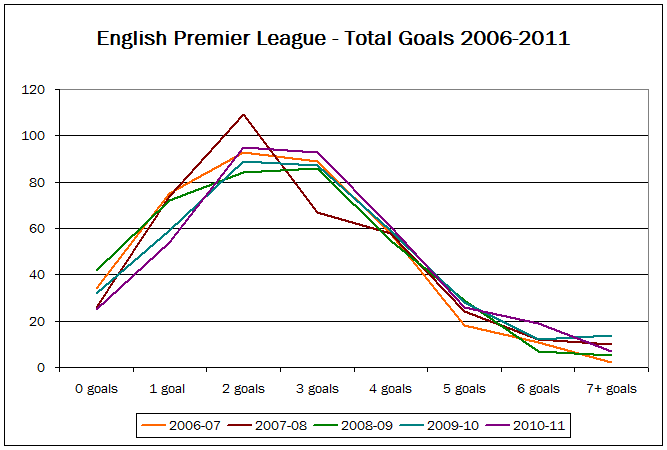
In this article we explore the “goal habits” of four major European leagues and compare them using simple line graphs.


English Premier League: 20 teams; 380 games per season
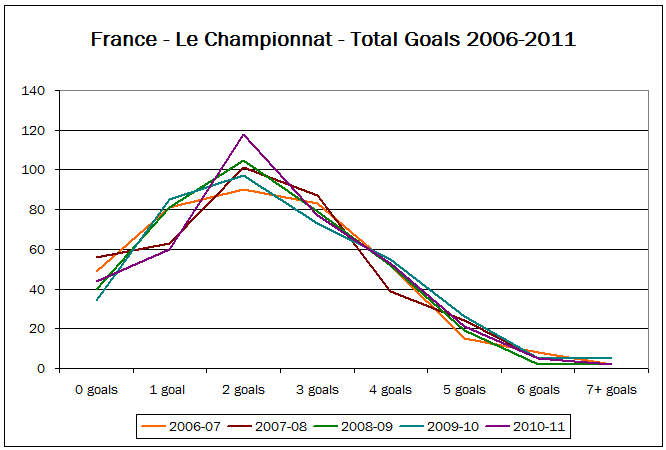

French Le Championnat: 20 teams; 380 games per season


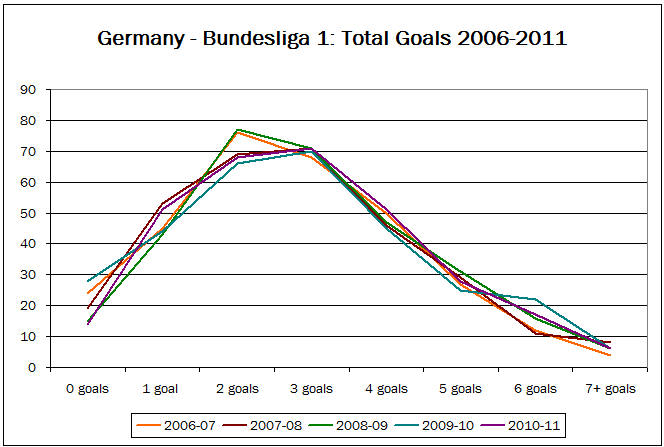
German Bundesliga 1: 18 teams; 306 games per season
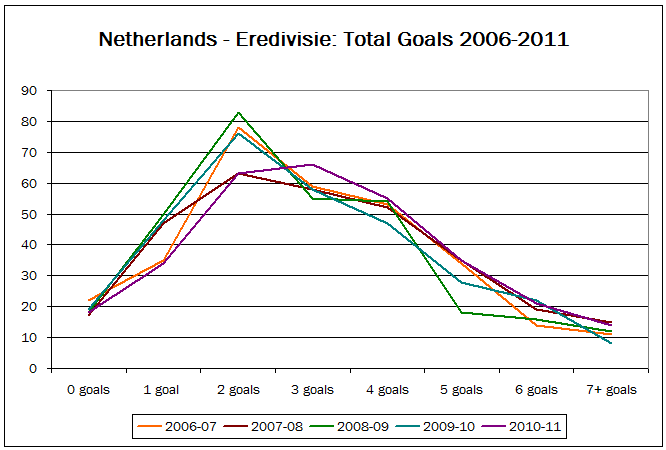

Dutch Eredivisie: 18 teams; 306 games per season


Photo: Vinicius Tupinamba (Shutterstock)

As you can see, the above graphs look fairly similar for all leagues: the curves rise steeply up to the threshold of two goals per game, peak around this figure, and then begin slowly dropping. This spread is called Poisson Distribution, which in maths, also determines things like radioactive decay (and the lingering strength of a Frenchman’s breath, no doubt!).

A radioactive particle disintegrates over time and the rate of decay can be calculated using the Poisson Distribution method. Such a distribution always begins at a known value, runs quickly up to a maximum, and then slowly drops as it approaches larger values.

The ‘peak’ threshold in football games to look at when betting is the average number of goals per game, analysed as we have here, over five years.

Dependant upon the league in question, the middle of the distribution always lies somewhere between two and three goals (hence the popularity of ‘Over & Under 2.5 Goals’ markets with both bookmakers and betting exchanges).

In our examples, the average numbers of goals per game are: Premier League: 2.6; Le Championnat: 2.3; Bundesliga 1: 2.8; Eredivisie: 3.0.

Mathematically speaking, the area in each graph between the horizontal axis (the ‘X’ axis) and the Poisson lines themselves always equates to ‘one’ purely because the probability that one of the results will happen is always 100% (i.e. it is 100% certain that the game must contain either zero, one, two, three goals, et cetera). Using the concept of ‘one’, exact probabilities can be calculated by using the “Euler’s Number” together with “K!” (faculty), and thus odds can be developed. But this is a higher level of mathematics than you need to know at this stage.

Photo: Smileus (Shutterstock)

There is a very descriptive and well explained article on Poisson Distribution (together with all the formulae) in the article What have a football team and a radioactive source in common? (www.weltderphysik.de).

However, this article is written in German, but easily translated using Babel Fish or Google Translate, for example.

Now, a closer look at our graphs above reveals the following trends:-

  • Bundesliga 1 exhibits the most regular goal distribution (all five seasons’ curves follow similar paths). This is despite having fewer games per season (306) than both the English Premier League and French Le Championnat (380 games per season). This is paradoxical because a more even distribution should be expected from a larger sample size.
  • There is a fairly consistent number of Dutch games finishing 0-0 each season.
  • Most of the French top-flight fixtures finish with less than six goals (i.e. the ‘Under 5.5 Goals’ market).
  • Within the two goal threshold (i.e. the ‘Under/Over 2.5 Goals’ market) all leagues show larger variances than in any of the other goal event categories.

Nota Bene: Spend a little time comparing the graphs and see what other discoveries you can make!

Relative Deviation

In order for you to understand the term ‘Relative Deviation’ it is necessary first to grasp the concept of ‘Absolute Deviation’.

For example, analysing our data set to quantify the average number of times that two-goal game events occur in a season is fairly easy. This is just a matter of adding up all of the two-goal game events over ‘X’ number of seasons and then dividing by ‘X’ to reach the average per season (where ‘X’ is the total number of seasons represented in the data set).

Photo: Andresr (Shutterstock)

Absolute deviation is the difference (or ‘deviation’) each season’s data set shows from the average for that data set. Effectively it is a simple way of comparing ‘apples’ (the average) with ‘pears’ (the deviation).

Relative deviation takes this idea one stage further and allows the comparison of different events with different results within the same data set.

It is difficult to envisage a direct comparison between, for example, two-goal events and three-goal events over a period of five years if they both have different frequencies and therefore different averages. Relative deviation analysis allows an ‘apples’ with ‘apples’ comparison of this information to be made.

A very quick and simple example to illustrate: Say a season contains 100 matches and over five seasons the average containing over 2.5 goals is 50. One of those seasons contains 52 matches over 2.5 goals. The absolute deviation for that season is 2% (i.e. 52% is 2% different from the average), whilst the relative deviation is 4% (52 divided by 50 and then shown as a percentage).

Say the average number of games per season containing over 5.5 goals is only five. The same season we are analysing contains seven such matches. Again, the absolute deviation is 2%, whereas the relative deviation is much larger at 40%. This means that the ‘error’ or deviation relative to the norm in this season was far greater for over 5.5 goals than for over 2.5 goals and thus, just tiny fluctuations in events with smaller average expectations have a greater tendency to ‘upset the apple cart’ when it comes to betting.

Taking the same information we used to build the first set of four graphs, we can now produce graphs showing the relative deviations (the average figure over five seasons), which will shed more light on the statistics from a betting perspective:

English Premier League 2006-2011: Over/Under 'X' Goals - Relative Deviation


French Le Championnat 2006-2011: Over/Under 'X' Goals - Relative Deviation


German Bundesliga 1 2006-2011: Over/Under 'X' Goals - Relative Deviation


Dutch Eredivisie 2006-2011: Over/Under 'X' Goals - Relative Deviation


Looking at the graphs above you will see that the ‘over’ and ‘under’ goal event curves again intersect somewhere between two and three goals in all four leagues.

The meaning of this is that bets on ‘over 0.5, 1.5 and 2.5 goals’ have a smaller variance (error), and are therefore “safer” bets than ‘under 2.5, 1.5 or 0.5 goals’, which show greater fluctuations in distribution over the five seasons.

Photo: Michiel de Wit (Shutterstock)

After the curves cross the situation changes and the under ‘X’ goals curve shows a diminishing relative deviation (error). Again, this means that bets become “more reliable” (they have a smaller and smaller variance) the higher the under ‘X’ goals event category climbs.

You can easily produce graphs like the ones presented above in whichever league you wish to analyse. Simply add-up all the zero goal matches plus the games with only one goal to produce the ‘under 1.5 goals’ result for a season; zero goals, plus one goal, plus two goals produces ‘under 2.5 goals’, and so on. Then, calculate the average of each respective over and under event category by dividing the sum in each category by the number of seasons you have analysed. After this, compare the observed results of each year with the average and compute the relative deviations (see also my article Calculation of Odds: Probability and Deviation). The final step is to build the average of the relative deviations (errors) for each year and you’ll come up (hopefully) with something similar to the above graphs.

Here’s another graph showing a comparison of relative deviations (errors) for the over ‘X’ goals market in all four leagues:

Relative Deviations (Errors): Over ‘X’ Goals - German Bundesliga 1, French Ligue 1 Le Championnat, Dutch Eredivisie, English Premier League

Interpretation:

  • French Ligue 1 (Le Championnat) and German Bundesliga 1 show the smallest deviation on over 2.5 goals; it might be worth developing a system to bet on over 2.5 goals in both these leagues. However, from the perspectives of the English Premier League and the Dutch Eredivisie, betting on over 2.5 goals should be avoided because the results show an average variance of around 6.7% per year. This means the results are statistically unreliable and fluctuate/vary up to four times more than the French and German counterparts.
  • German Bundesliga 1 gives the most consistent impression and except for the ‘over 5.5 goals’ threshold (where the Dutch show the smallest deviation), the Germans have their noses in front in all the other over ‘X’ goals betting categories making this an ideal league for consistently accurate over ‘X’ goals forecasts.
  • Exactly the opposite occurs in the English Premier League (which has the highest deviations) and avid followers will also agree that results in this league are never easily predictable, with regular surprises and ‘upsets’.

To complete the story, here’s the combined graph for the under ‘X’ goals market:

Relative Deviations (Errors): Under ‘X’ Goals - German Bundesliga 1, French Ligue 1 Le Championnat, Dutch Eredivisie, English Premier League

Interpretation:

  • Under 0.5 goals (i.e. 0-0 results) show the Dutch league with the lowest deviation and therefore producing the most regular and reliable results.
  • In the under 2.5 goals market the French have significantly less deviation than any of the other three leagues. We have already seen they are worth a punt on the over 2.5 goals market, so concentrating your analytical resources on over/under 2.5 goals in Le Championnat is the way to go, but again, avoid the Dutch and the English.
  • For more “reliable” bets (i.e. higher probability, but obviously lower odds offered) you should consider looking at the under 3.5 and/or under 4.5 goals categories and, no surprise, just stick to the French or German top-flight leagues.

Summary
Betting on the German Bundesliga 1 and/or French Le Championnat on over 1.5 goals (or even over 2.5 goals) as well as under 3.5 goals (and/or under 4.5 goals) seems to be statistically rather a ‘sure thing’, so long as you are planning a strategy around securing long-term profits using a proper staking plan. You will also need a mathematical advantage or ‘edge’, which means never betting under ‘value’. The latter part of the equation is probably the biggest challenge!

Betting ‘under’ value will lose in the long run as described in the article Calculation of Odds: Probability and Deviation.

However, if you need to learn how to evaluate and process raw data, calculate odds, probabilities and recognise VALUE, please look no further than Socccerwidow’s basic course.

Further reading about statistical goal distribution:
Goal Production In Six Leagues, Or: Are the Eredivisie and Ligue 1 Different?
Goals Per Game Ratios

As ever, thanks for reading and best of luck with all your football betting!


Print Friendly and PDF Last Update: 9 May 2012

Categories:Betting Courses & Tutorials Betting Maths Case Studies


No comments yet.

Leave a Reply


seven + = 8


Notify me of followup comments via e-mail. You can also subscribe without commenting.